
Customs Closure Does Not Mean "Island Closure" – These Claims Are Inaccurate!
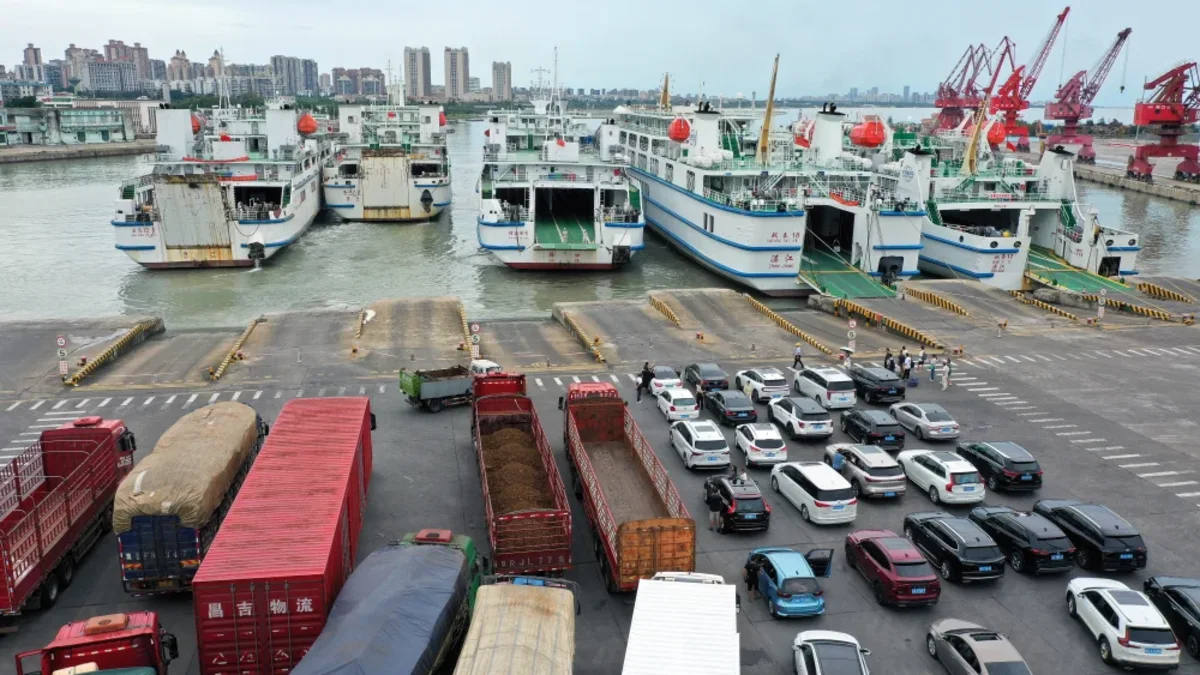
Customs Closure Does Not Mean "Island Closure" – These Claims Are Inaccurate!
Xinhua News Agency, Haikou, December 16 (Reporters Wu Maohui, Luo Jiang) – Hainan Free Trade Port will launch customs closure operations on the 18th of this month. Customs closure does not mean "island closure"; mainland residents will still enjoy convenient travel and business trips to Hainan. Claims such as "tax haven" and "houses becoming offshore assets" are also unreliable...
Rumor 1: Customs Closure Equals "Island Closure," Making It Inconvenient for Mainland Residents to Travel to Hainan
Fact:
After the launch of customs closure operations, the management method for mainland residents entering and exiting Hainan will remain the same as it is now.
Customs closure mainly involves upgrading the management of "goods" and has little impact on the flow of "people." In the future, the connection between Hainan and overseas will be referred to as the "first line," featuring freer and more convenient movement of goods; the connection between Hainan and the mainland will be the "second line," focusing on regulating goods and taxation to prevent smuggling.
For ordinary tourists, whether traveling from the mainland to Hainan or returning to the mainland from Hainan via airports or ports, the process will remain unchanged. In the future, with improved services, everyone's travel experience will be even better.
Rumor 2: Customs Closure Means the Completion of the Free Trade Port
Fact:
Launching customs closure operations is an important milestone in the construction of the free trade port, but it is far from the end.
Customs closure can be regarded as the start of a new phase in the opening-up and development of the free trade port. According to the plan, a preliminary policy and institutional system for the free trade port will be established by 2025, the system and operation model will be more mature by 2035, and a high-level free trade port will be fully built by the middle of this century.
Internationally, mature free trade ports have gone through decades of development from the launch of customs closure to the completion of full functionality. Hainan Free Trade Port still has a long way to go after customs closure and needs to steadily advance various reforms.
Rumor 3: Hainan Will Become a "Tax Haven"
Fact:
Hainan's preferential tax policies have strict restrictions, with the goal of developing the real economy rather than creating a "tax haven."
A so-called "tax haven" usually implies undifferentiated ultra-low tax rates, lack of transparency, and loose supervision – which is fundamentally different from Hainan's tax policies. For example, the 15% corporate income tax discount applies only to enterprises in encouraged industries and requires them to conduct "substantive operations" in Hainan: they must have real offices, personnel, and business activities, and cannot arbitrage by setting up shell companies.
At the same time, Hainan has established strict anti-tax avoidance rules and a financial supervision system. Through technical means such as an "electronic fence," it has built an "open yet orderly" tax environment and a capital flow environment that is "liberalized yet controllable." It aims to become a "highland of institutional opening-up" and welcomes enterprises that truly intend to invest and operate.
Rumor 4: Hainan's Houses Will Become "Offshore Assets"
Fact:
Hainan's real estate remains subject to domestic laws and policies.
"Offshore assets" generally refer to assets owned by investors outside their country or region of residence, which are not regulated by their home country. After customs closure, although Hainan will implement special policies, it will still operate within the framework of national laws and macro-management. Real estate regulation will be tailored to local conditions, but the principle of curbing speculative real estate speculation and safeguarding residents' housing needs will not waver. The ownership, right to use, and other rights and interests of Hainan's real estate are still protected by domestic laws and regulations. Their value will mainly depend on the increased demand for residential and office space brought about by the actual development of the free trade port, as well as the scarcity of island resources – rather than being speculated as a speculative label or symbol outside regulatory control.
Related News


